
View Only Document Sharing: The Complete Guide to Secure Browser-Based Document Control
View-Only Document Sharing: The Complete Guide to Secure Browser-Based Document Control
Share sensitive documents without sending the original file. View-only document sharing keeps access in the browser, reduces uncontrolled downloads, and gives organisations stronger visibility, governance, and revocation control.
Traditional file sharing was built around delivery. View-only document sharing is built around control after access begins.
 Start Free Trial (No Credit Card Required)
What Is View-Only Document Sharing?
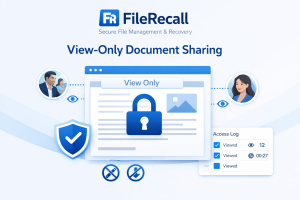
View-only document sharing is a secure method of distributing documents where recipients can view files in a controlled browser environment without downloading, copying, or permanently storing the original file.
Instead of sending attachments or standard file links that expose the document itself, view-only sharing provides access to a protected, streamed version of the file that remains securely hosted on the sender’s system.
This changes the underlying model of digital document distribution. Traditional systems assume that once a file is sent, control moves with it. View-only systems remove that assumption and replace it with centrally governed access.
That difference is more important than it first appears. Most organisations already have methods for storing documents securely. The real weakness begins when documents have to be shared outside the system in which they were originally protected.
When a business uses view-only document sharing, it is not just changing the format of delivery. It is changing what is being delivered in the first place. Instead of transferring a file, the organisation is granting controlled access to information.
👉 Related reading: Secure Document Sharing
Why View-Only Document Sharing Exists
Traditional file sharing was built around one simple objective: get the file to the recipient. Email attachments, Dropbox links, Google Drive shares, OneDrive folders, and transfer links all follow this model.
The problem is not that these systems fail to move files. The problem is that they surrender meaningful control as soon as that movement is complete.
Once a file is delivered, several things become possible immediately:
- It can be copied endlessly.
- It can be forwarded to people outside the intended workflow.
- It can be saved to personal or unmanaged devices.
- It can continue circulating long after a newer version exists.
- It can disappear from the sender’s audit trail.
Even enterprise-grade systems still tend to rely on file delivery as their default sharing logic. That creates a structural weakness in modern information security, because the sender loses power at the precise point where external exposure begins.
The more sensitive documents an organisation shares externally, the greater the number of uncontrolled copies that can exist beyond its environment. View-only document sharing exists to remove this weakness by removing file delivery from the primary workflow.
Instead of sending the file, the organisation grants access to a live controlled viewing environment.
The FileRecall Difference
The most important difference between traditional file sharing and a view-only system is not simply storage, encryption, or permissions. It is control after delivery.
Traditional systems generally follow the same pattern. They send the file, rely on user behaviour once it is received, and lose meaningful visibility if the file is downloaded or redistributed.
A view-only system such as FileRecall is built differently. Instead of sending the file itself, it stores the document securely on the server, renders it dynamically in a browser viewer, and streams content in real time.
That creates a different security posture:
- No file leaves the controlled system by default.
- No persistent local copy is created as the standard sharing outcome.
- Access is session-based rather than file-based.
- Every interaction can be tracked more consistently.
This transforms documents from static distributed assets into governed access sessions. For organisations sharing sensitive information, that shift can materially improve governance, reduce duplication, and create stronger operational visibility.
👉 Related reading: Secure Client Document Portal
Why Downloads Are the Weakest Link in Document Security
Downloads are the most important failure point in traditional document sharing. A platform may secure storage, require sign-in, protect transmission, and still fail the moment the file is downloaded to a device outside central control.
Once a file is downloaded, several forms of governance begin to collapse. Revocation becomes limited, copying becomes easy, forwarding becomes invisible, and retention becomes almost impossible to enforce comprehensively.
This creates a permanent gap between intended control and actual behaviour. In real environments, that gap often leads to outdated documents continuing to circulate, confidential materials being retained on personal devices, and compliance reporting becoming incomplete or misleading.
This is why permissions alone do not solve the deeper problem. A platform can still look secure while allowing the very event that breaks control: the creation of a portable copy outside the sender’s environment.
View-only systems change this by removing download from the primary workflow. Instead of handing over the original file, they render content inside a controlled browser session where access remains closer to the sender’s governance layer.
👉 Related reading: Password Protected Document Sharing
Real-World Security Failures Usually Look Ordinary
Many organisations assume document security failures begin with hacking, theft, or obvious misconduct. In reality, many failures begin with ordinary workflow behaviour.
The file is sent to the wrong person. It is forwarded internally without oversight. It is downloaded for convenience and left on a personal laptop. An outdated version is saved and later re-used by mistake.
These are not dramatic incidents. They are operational habits.
This is exactly why traditional file sharing becomes more dangerous as an organisation grows. When systems rely on user discipline after a file is delivered, each new stakeholder, device, inbox, and external collaborator becomes another place where control can fail.
View-only document sharing reduces this dependence on perfect behaviour. It shifts the burden from human caution to system design, so that even when workflows are busy or imperfect, the document itself remains harder to distribute outside approved channels.
How Browser-Based Document Streaming Works
Browser-based document streaming replaces file transfer with real-time rendering. Instead of sending a document as a static file, the system converts it into a secure stream displayed inside a controlled browser viewer.
The process typically works like this:
- The document is uploaded to secure server storage.
- An access policy is applied, including permissions, expiry, watermarking, or device restrictions.
- A secure link is generated.
- The recipient opens the link in a browser.
- The document is rendered as a stream inside a controlled viewer.
- The viewing session is logged and monitored.
This model creates several practical advantages. Documents remain centrally controlled, access can be changed or revoked, usage signals can be captured in real time, and the original file does not have to exist as a freely transferable object outside the system.
It also supports dynamic enforcement of governance rules such as time-based expiry, device restrictions, per-session watermarking, and view-only rendering policies.
Key Benefits of View-Only Sharing
The benefits of view-only document sharing go beyond simple protection from download. Its real value is that it redefines how external document access is managed.
- Central control remains intact
The sender keeps the document within a governed environment instead of treating distribution as a one-way event. That makes it easier to preserve one source of truth and respond to policy changes without trying to recover multiple file copies.
- File exposure is reduced
Because the original file is not routinely handed over, there are fewer opportunities for uncontrolled duplication, local archiving, and onward forwarding.
- Access is session-based
The system governs the viewing experience directly. This is fundamentally different from unlocking a file and hoping it is handled appropriately after access is granted.
- Visibility is stronger
Interaction can be observed through viewing sessions rather than inferred from weak delivery signals. That provides a more useful operational picture than a simple “sent” or “opened” assumption.
- Compliance alignment improves
When access occurs in a controlled environment, organisations are better placed to support auditability, revocation, and handling discipline.
👉 Related reading: controlled Document Access
Why View-Only Is Better Than Password-Protected PDFs
Password-protected PDFs are often mistaken for a strong document control solution. In practice, they remain a file-delivery model with a gate at the front.
Once a recipient enters the password, the file is usually fully accessible. It can be saved locally, forwarded, duplicated, stored in other systems, or retained indefinitely outside the sender’s environment.
The password controls initial access, but it does not create ongoing governance. That is a critical weakness in regulated industries and high-trust professional settings where risk usually begins after the document is opened, not before.
View-only document sharing changes this by replacing file unlocking with session control. The recipient is permitted to view the information, but the system is designed to avoid exposing the underlying file as a freely transferable asset.
That difference is especially important when dealing with confidential reports, due diligence materials, board papers, legal documents, financial records, and employee information.
👉 Related reading: How to Recall a Sent File
Email vs Browser-Based Document Streaming
The strategic difference between email-style sharing and browser-based streaming is not convenience. It is control after access begins.
Feature | Dropbox / Google Drive | Password-Protected PDF | View-Only Sharing | |
Sends the original file | Yes | Yes or exposes it for download | Yes | No by default |
Requires or encourages download | Yes | Often | Yes | No |
Real-time tracking | No or very limited | Limited | No | Yes |
Instant revocation | No | Partial | No | Yes |
Prevents forwarding of the file | No | No | No | Strongly reduces it |
File remains on the server | No | Not as the only usable outcome | No | Yes |
Controlled viewing session | No | No | No | Yes |
This comparison highlights the larger shift under way. Traditional systems distribute files and lose control after delivery. View-only systems control access centrally and preserve governance throughout the document lifecycle.
Why Cloud Permissions Still Fall Short
Cloud storage tools often include permission controls, and those controls can be useful. But they usually govern who can open a file or link, not how the document behaves once access is granted.
That distinction matters because permissions can create a false sense of control. A system may look secure at the access point while still allowing the document to be downloaded, copied externally, stored elsewhere, or re-shared outside the intended workflow.
This is why many cloud-based controls are effectively soft controls. They influence access at the front door, but they do not always enforce behaviour once the user is inside.
View-only document sharing is stronger because it moves closer to hard control enforcement. Instead of merely restricting a link, it changes the document-sharing model so the file itself is not routinely released into the user’s possession.
👉 Related reading: Document Access Control
The Document Lifecycle Control Model
Traditional file sharing treats documents as static objects. Once sent, they continue to exist and circulate independently across inboxes, folders, laptops, and secondary systems.
View-only document sharing introduces a different model: document lifecycle control.
In this model, every document moves through governed stages:
- Upload and creation.
- Controlled distribution.
- Active browser-based viewing.
- Expiry, revocation, or policy change.
This is critical because most document risk emerges after the initial share. If circumstances change, access rules can be adjusted centrally instead of relying on every recipient to delete or stop using a previously downloaded file.
Lifecycle control allows organisations to define how long information remains accessible, who may view it at each stage, and what happens when access conditions change. It turns document sharing into an actively managed process rather than a one-off distribution event.
Why Visibility Matters More Than Storage Security
Most organisations already have some form of secure storage. Storage matters, but it only protects documents while they remain in the storage environment.
The real risk begins during distribution and after external access is granted. Once a document leaves the sender’s environment through download, visibility often disappears, duplication becomes untraceable, and governance becomes fragmented.
View-only systems solve this by maintaining a stronger connection between the sender and the access event. Because the document is viewed within a controlled environment, the organisation can observe behaviour more directly and maintain a fuller audit trail.
That may include whether the document was opened, how long it was viewed, whether it was revisited, and whether access remained active over time.
This is not only a compliance advantage. It is also an operational advantage. When teams know how stakeholders are engaging with documents, they can improve follow-up timing, prioritise active opportunities, and reduce unnecessary chasing.
Visibility comparison
Visibility area | Why it matters |
Open activity | Confirms whether engagement has actually started. |
Viewing duration | Gives a stronger signal than simple delivery status. |
Repeat access | Helps identify continued interest or ongoing review. |
Revocation status | Makes it easier to align changing permissions with actual use. |
Visibility Is Also a Competitive Advantage
Document visibility is often discussed as a security or compliance feature, but it also has commercial value.
When an organisation can see who opened a document, how long they spent with it, whether they returned to it, and when engagement dropped away, it gains insight into stakeholder intent.
That can improve workflow efficiency in several ways:
- Follow-ups can be prioritised based on actual engagement.
- Stalled deals can be identified earlier.
- Teams can reduce speculative chasing.
- Commercial timing can improve because activity signals are stronger.
For firms handling proposals, client documents, deal materials, board reporting, or regulated disclosures, visibility is not just a defensive control. It is also a source of practical operating intelligence.
Compliance and Governance Benefits
Modern compliance frameworks are increasingly concerned with handling, not just storage. Organisations are expected to demonstrate who accessed a document, when it was accessed, how long access remained active, and whether access could be revoked or controlled appropriately.
View-only systems support this more naturally because the viewing event itself occurs within the governed environment. Instead of trying to reconstruct behaviour after a file has moved through multiple devices and inboxes, the organisation can rely on a stronger central audit trail.
This is especially relevant in environments such as financial services, legal practice, HR administration, healthcare, and board governance, where confidentiality, privilege, privacy, and auditability are central obligations.
For these teams, secure storage alone is not enough. The real compliance challenge lies in controlled disclosure, monitored access, and continued governance after sharing begins.
Industries That Depend on View-Only Document Sharing
View-only document sharing is especially valuable in sectors where sensitive material must be reviewed by external or semi-external parties without allowing the document to circulate freely.
Accountants and finance teams
Tax packs, financial statements, management accounts, compliance reports, and client reporting packs often contain highly sensitive financial data. In these workflows, auditability and confidentiality matter as much as convenience.
A view-only model can reduce the spread of local file copies across inboxes, desktops, and personal devices while preserving a stronger chain of control.
👉 Related reading: Secure File Sharing for Accountants
Lawyers and legal teams
Contracts, evidence files, litigation documents, due diligence papers, and privileged correspondence frequently require strict confidentiality and strong access discipline.
When legal documents are distributed as attachments, it becomes harder to maintain a clean governance trail. Browser-based view-only access helps reduce uncontrolled duplication and supports tighter post-share control.
👉 Related reading: Secure File Sharing for Lawyers
HR teams
Employment contracts, payroll records, onboarding packs, disciplinary materials, and performance documents contain personal information that should not drift into unmanaged systems.
View-only sharing can support stronger handling practices by reducing downloads and making access more governable across sensitive employee workflows.
👉 Related reading: Secure File Sharing for HR Teams
Investors, advisers, and deal teams
Due diligence materials, investment summaries, fundraising decks, transaction packs, and commercially sensitive disclosures often need to be reviewed by multiple stakeholders under time pressure.
A view-only model helps maintain control while still allowing information to be shared widely enough to support deal progression. That is particularly valuable when the downside of uncontrolled circulation is high.
👉 Related reading: Controlled Document Access
Board directors and executive teams
Board packs, strategy papers, executive updates, and confidential reports can be among the most sensitive documents a business produces.
Using a controlled browser-based access model reduces the risk of those materials being forwarded, saved locally, or left circulating after they are no longer current.
👉 Related reading: Secure Browser Document Viewer
Healthcare providers
Patient records, treatment plans, clinical documentation, and sensitive medical records require strong confidentiality and disciplined handling.
View-only sharing supports privacy-sensitive workflows by keeping access governed rather than allowing unrestricted file distribution.
Why Businesses Are Moving Away From Attachments
Attachments remain common because they are familiar. They do not remain common because they are ideal for secure modern collaboration.
Today’s workflows involve distributed teams, external stakeholders, remote decision-making, and high-frequency movement of sensitive documents across systems. In that environment, each attachment creates another uncontrolled copy and another potential compliance blind spot.
As scale increases, these risks become systemic rather than occasional. Visibility falls away, version control weakens, and governance becomes harder to prove.
View-only document sharing solves this by preserving a single source of truth and surrounding it with controlled access. Instead of multiplying files at every touchpoint, organisations centralise the document and manage the session through which it is viewed.
Why This Model Scales Better Than Email
Email can feel workable at small scale, particularly in relationships built on trust and familiarity. But as document volume increases, email-based sharing begins to break down.
Visibility disappears after send. Versions multiply across long threads. Attachments are retained in multiple inboxes. Sensitive information spreads through forwarding and unmanaged archiving.
At modest volume, these issues may seem manageable. At larger volume, they become a system-level risk.
View-only sharing scales more cleanly because the organisation retains a single source of truth, centralises access, logs behaviour automatically, and avoids creating duplicate files as the default workflow outcome.
That is why larger organisations and compliance-sensitive teams are increasingly moving away from attachment-based sharing models.
Browser-Based Security as the New Standard
Browser-based document systems align closely with zero-trust security principles. Instead of assuming that an authenticated recipient should gain enduring control over a file, zero-trust models treat every access event as something that should be verified, constrained, and monitored.
In a document-sharing context, that means:
- No implicit trust of the recipient after delivery.
- Every access event is controlled.
- No permanent file exposure is treated as the default outcome.
- Governance continues after the first click.
This is increasingly relevant in enterprise settings where compliance and data governance are critical. It also creates a stronger foundation for future integrations such as AI document summarisation, automated compliance review, and secure collaborative commentary in controlled environments.
Common Misconceptions About View-Only Sharing
Many organisations continue to make document-sharing decisions based on assumptions that no longer hold up under modern compliance and governance expectations.
“Password-protected PDFs are secure enough”
They may slow access, but they do not solve the governance problem created by file delivery. Once opened, the file can still leave the sender’s environment and circulate indefinitely.
“Cloud links are private by default”
A private link can still be forwarded, and if the platform allows download, the document can still become an uncontrolled file outside the intended workflow.
“Email recall removes the risk”
Recall functions do not retrieve files that have already been downloaded, copied, or forwarded. They are not a substitute for a governed access model.
“Trusted recipients won’t create problems”
Most document leakage is accidental rather than malicious. The real question is not whether people are trustworthy. It is whether the system is designed to remain safe when people behave normally under time pressure.
Controlled Document Access Is the Future Model
View-only document sharing is not just a useful feature. It is part of a broader shift toward controlled document access.
In this model, organisations stop asking, “How do we send this file?” and start asking, “How should this information be accessed, governed, and monitored?”
That shift is subtle, but it is fundamental. It moves document sharing away from logistics and toward access design.
Instead of sending a file and hoping it is handled correctly, organisations define who can access it, how they can access it, how long access lasts, and what happens when permissions need to change.
This is why view-only systems are better understood as access governance platforms than simple file-sharing tools.
Related reading: Secure Document Management for Professional Services
External References
Broader access-control and secure-design principles are supported by external reference frameworks including NIST, ISO/IEC 27001, and OWASP.
Start Using View-Only Document Sharing Today
View-only document sharing enables organisations to distribute sensitive information without losing control over it. By replacing file delivery with controlled browser-based access, organisations gain stronger governance, better visibility, improved compliance alignment, and more secure collaboration at scale.
For businesses that handle confidential client information, board papers, employee records, financial reports, legal material, or due diligence documentation, that is not a marginal improvement. It is a structural one.
FileRecall provides a secure document streaming system designed for modern professional workflows. It helps organisations move away from attachment-based habits and toward controlled document access that is better aligned with today’s security, governance, and compliance demands.