
Secure Browser Document Viewer: The Safer Way to Share Confidential Documents
Introduction
Every day, businesses share confidential documents containing sensitive financial, legal and commercial information. From contracts and tax returns to board papers and investor presentations, these documents often contain data that should only be seen by authorised recipients.
Unfortunately, traditional file-sharing methods usually require recipients to download the original document.
Once that happens, the sender loses much of their control. The file can be copied, forwarded, stored indefinitely or shared with people who were never intended to receive it.
This is why more organisations are adopting a secure browser document viewer instead of relying on email attachments or cloud storage downloads.
A secure browser viewer allows authorised users to read documents directly within their web browser while the original file remains protected on the server. Rather than distributing copies, organisations provide secure access, helping maintain greater control over confidential information throughout its lifecycle.
Whether you’re sharing PDF reports, Microsoft Word documents or PowerPoint presentations, browser-based viewing offers a smarter and more secure way to collaborate.
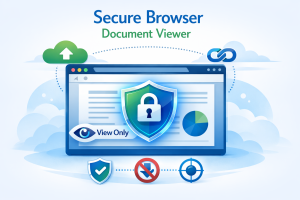
What Is a Secure Browser Document Viewer?
A secure browser document viewer is an online document viewing system that allows users to access files through a web browser without receiving the original downloadable document.
Instead of emailing a PDF or sharing a cloud storage download link, the sender uploads the document to a secure platform.
Recipients receive a secure viewing link that opens the document inside a protected HTML5 viewer.
The original file remains securely stored on the server while authorised users view its contents online.
This approach changes document sharing from file distribution to controlled document access.
👉 Related reading: View-Only Document Sharing
Why Traditional File Sharing Isn’t Enough
Businesses commonly use:
- Email attachments
- Dropbox
- Google Drive
- Microsoft OneDrive
- WeTransfer
These services are convenient but typically provide access to the original document.
Once downloaded, documents can easily be:
- Saved permanently
- Forwarded to others
- Uploaded elsewhere
- Printed
- Stored on unmanaged devices
For organisations handling confidential information, this creates unnecessary security and compliance risks.
A secure browser document viewer helps minimise those risks by avoiding traditional downloads.
How a Secure Browser Viewer Works
The process is simple:
- Upload your document.
- Apply security settings.
- Generate a secure viewing link.
- Share the link with authorised users.
- The document opens inside a secure browser viewer.
- Viewing activity is recorded.
- Access can be revoked at any time.
Because recipients view the document online rather than downloading it as a standard attachment, organisations maintain significantly greater control.
 Start Free Trial (No Credit Card Required)
Protect Confidential Documents Before They’re Downloaded
Replace email attachments with secure browser-based document viewing.
Start your free FileRecall trial today.
Key Security Features
A modern secure browser document viewer provides far more than online viewing.
Browser-Based Viewing
Recipients can securely view documents directly within their web browser without receiving the original file.
Permanent Personalised Watermarks
Every page can display:
- User name
- Email address
- Date
- Time
Visible watermarks discourage unauthorised sharing while increasing accountability.
Password Protection
Require recipients to authenticate before accessing confidential documents.
Activity Tracking
See:
- Who viewed a document
- When it was viewed
- Viewing history
- Access activity
Complete visibility improves governance and compliance.
Instant Access Revocation
If circumstances change, viewing permissions can be removed immediately without recovering downloaded files.
Link Expiry
Automatically disable access after a specified time period.
Browser Viewer vs Traditional Downloads
Feature | Email Attachment | Cloud Storage | Secure Browser Viewer |
Sends original file | ✔ | ✔ | ✖ |
Browser viewing | Limited | Limited | ✔ |
Password protection | Limited | ✔ | ✔ |
Personalised watermarks | ✖ | ✖ | ✔ |
Activity tracking | ✖ | Partial | ✔ |
Instant access revocation | ✖ | Partial | ✔ |
Original file remains protected | ✖ | ✖ | ✔ |
Who Benefits?
Accountants
Securely share tax returns, BAS statements and financial reports.
👉 Related reading: Secure File Sharing for Accountants
Lawyers
Protect contracts, legal agreements and confidential case documents.
👉 Related reading: Secure File Sharing for Lawyers
Financial Advisers
Share investment reports and financial plans securely.
👉 Related reading: Secure File Sharing for Financial Advisors
Investors
Protect due diligence documents, board papers and financial models.
👉 Related reading: Secure Investor Document Management
Professional Services
Consultants, engineers and business advisers frequently exchange confidential client information.
Why Browser-Based Viewing Is More Secure
Unlike downloadable attachments, browser viewing allows organisations to maintain greater oversight throughout the sharing process.
Benefits include:
- Reduced document distribution
- Improved accountability
- Better compliance
- Stronger document governance
- Greater visibility into document activity
Instead of hoping confidential files remain private after download, businesses maintain ongoing control over access.
Start Free Trial (No Credit Card Required)
Share Documents Securely Without Downloads
Maintain control over confidential business documents using FileRecall’s secure browser document viewer.
Try FileRecall Free Today.
Best Practices
To maximise document security:
- Avoid sending confidential documents as email attachments.
- Use browser-based viewing whenever possible.
- Apply personalised watermarks.
- Enable password protection.
- Monitor viewing activity.
- Set expiry dates.
- Revoke access when documents are no longer required.
- Regularly review sharing permissions.
These practices significantly reduce the risk of confidential information being copied or distributed beyond authorised users.
Frequently Asked Questions
Can users download documents?
A secure browser document viewer is designed to allow authorised viewing while helping prevent recipients from receiving the original downloadable document.
Does it work with PDF, Word and PowerPoint?
Yes.
Modern browser viewers support PDF, DOCX and PPTX documents.
Can access be revoked later?
Yes.
Authorised users can disable viewing permissions instantly whenever required.
Does it work on mobile devices?
Yes.
Recipients can securely access documents from desktop computers, tablets and smartphones.
The Future of Secure Document Sharing
Businesses are moving away from attachment-based document sharing.
Rather than distributing copies of confidential files, organisations increasingly prefer browser-based viewing that allows authorised access while maintaining greater control over the original document.
This approach supports stronger security, better compliance and improved client confidence.
As privacy regulations and cyber security requirements continue to evolve, secure browser document viewers are becoming an essential part of modern document management.
Start Free Trial (No Credit Card Required)
Ready to Upgrade Your Document Security?
Discover how FileRecall helps businesses securely share confidential documents through a secure browser viewer—without distributing the original files.
Start Your Free Trial Today.
Conclusion
Traditional file sharing distributes documents.
A secure browser document viewer distributes access.
By allowing recipients to view documents online while keeping the original files securely protected, organisations can significantly improve document security, accountability and control.
Whether you’re sharing contracts, financial reports, client records or investor presentations, browser-based viewing provides a smarter alternative to traditional email attachments and cloud storage downloads.
The best way to protect a confidential document is to avoid distributing the original file in the first place.
👉 Related Reading
- 👉 How to Recall a Sent File
- 👉 Share Documents Without Downloading
- 👉 Prevent PDF Downloads
- 👉 Secure Investor Document Management
- 👉 Secure Client Document Portal