
Controlled Document Access: The Future of Secure Information Sharing
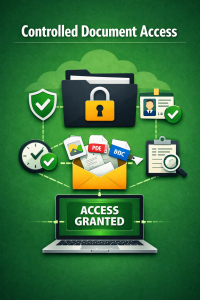
Controlled document access is a modern approach to secure file distribution where organisations maintain ongoing control over documents even after they are shared.
Instead of sending files as static attachments, controlled document access ensures that every document remains governed, trackable, and revocable throughout its entire lifecycle.
This represents a fundamental shift away from traditional file sharing models, where control is lost the moment a document leaves the sender’s system.
Platforms like FileRecall enable controlled document access through browser-based document streaming, allowing organisations to share sensitive files without losing visibility or governance.
 Start Free Trial (No Credit Card Required)
What Controlled Document Access Actually Means
Controlled document access refers to the ability to define, enforce, and maintain rules around how a document is accessed after it has been shared.
This includes:
- Who can view the document
- When it can be accessed
- How long access remains active
- Whether access can be revoked
- Whether the document can be downloaded or shared
Unlike traditional file sharing, where control ends at the point of delivery, controlled document access extends governance beyond the initial send.
It transforms documents from static files into managed digital assets.
👉 Related reading: View-Only Document Sharing
👉 Related reading: Secure Document Sharing
Why Traditional File Sharing No Longer Works
Traditional file sharing systems were designed for convenience, not control.
Email attachments, cloud links, and file transfer tools all operate on the same principle: deliver a copy of the file to the recipient.
Once that happens:
- The sender loses visibility
- The file can be duplicated infinitely
- Access cannot be reliably revoked
- Compliance becomes difficult to enforce
Even modern tools like Google Drive, Dropbox, and OneDrive still rely on file delivery as the core mechanism.
This creates a structural security gap.
The more frequently an organisation shares sensitive documents, the more uncontrolled copies exist outside its environment.
Controlled document access exists to solve this problem at the system level.
The Shift From File Delivery to Access Control
The most important change in modern document security is this:
Organisations are no longer sending files — they are controlling access.
In traditional workflows, the file is the unit of exchange.
In controlled document access systems, access is the unit of exchange.
Instead of transferring documents, organisations:
- Store files securely in a central system
- Generate controlled access sessions
- Stream content to authorised users
- Monitor all interactions in real time
This shift removes the concept of uncontrolled file distribution entirely.
How Controlled Document Access Works
Controlled document access systems operate through a structured workflow:
Upload Document
↓
Encrypted Storage
↓
Access Rules Applied
↓
Secure Access Link Generated
↓
Recipient Opens Browser Session
↓
Document Rendered Securely
↓
Activity Tracked in Real Time
↓
Access Can Be Revoked Instantly
This model ensures that the document never exists as an uncontrolled file once shared.
Instead, it exists as a managed, trackable viewing session.
Key Capabilities of Controlled Document Access
Controlled document access systems typically include:
- Access Control
Define exactly who can view a document.
- Revocation
Instantly remove access even after a document has been opened.
- Expiry Rules
Automatically disable access after a defined time period.
- Activity Tracking
Monitor when and how documents are accessed.
- Watermarking
Embed user-specific identifiers to discourage unauthorised sharing.
- Browser-Based Viewing
Ensure documents are viewed without requiring downloads.
These capabilities work together to maintain full lifecycle control over sensitive information.
Why Downloads Break Document Security
Downloads are the weakest point in any traditional file sharing system.
Once a document is downloaded:
- It exists outside system control
- It can be copied, forwarded, or stored indefinitely
- It cannot be reliably revoked
- It becomes invisible to tracking systems
Even with encryption or permissions, downloaded files are no longer governed.
Controlled document access removes this risk by eliminating downloads from the primary workflow.
Instead of transferring files, users interact with a secure viewing environment inside the browser.
Start Free Trial (No Credit Card Required)
Start using controlled document access today.
Industries That Rely on Controlled Document Access
Controlled document access is used across industries where confidentiality, compliance, and control are essential.
Accountants
Secure tax documents, financial statements, and client reports.
Lawyers
Protect privileged communications, contracts, and case materials.
HR Teams
Manage employee records, onboarding documents, and performance reviews.
Financial Advisors
Control access to investment reports and client portfolios.
Investors
Secure due diligence documents and deal flow materials.
Healthcare Providers
Protect sensitive patient information and compliance documentation.
Across all industries, the requirement is the same:
Maintain control over documents after they are shared.
H2: Controlled Document Access vs Traditional Sharing
Traditional systems:
- Send files directly
- Lose control after delivery
- Rely on trust-based behaviour
Controlled document access systems:
- Maintain central control
- Enforce access rules dynamically
- Track every interaction
- Prevent uncontrolled distribution
This represents a structural shift in how organisations manage sensitive information.
Why Controlled Document Access Matters Now
The volume of digital document exchange has increased dramatically across all industries.
As organisations scale:
- More external sharing occurs
- More stakeholders are involved
- More sensitive data is transmitted
- More compliance obligations apply
Traditional file sharing systems cannot enforce governance at scale.
Controlled document access introduces structure, visibility, and enforcement into this process.
It ensures that security is not dependent on user behaviour, but on system design.
Where Controlled Document Access Is Heading
Controlled document access is part of a broader shift toward:
- Zero-trust security models
- Browser-native workflows
- Continuous compliance monitoring
- AI-assisted document governance
- Lifecycle-based information control
In this model:
- Files are no longer static assets
- Access becomes the controlled layer
- Governance becomes continuous rather than reactive
The Risks of Not Controlling Document Access
When organisations rely on traditional file sharing methods, they introduce ongoing risk every time a document is shared externally.
These risks are often not immediate — they build over time.
Common issues include:
- Outdated versions circulating across teams
- Sensitive documents stored on personal devices
- Unauthorised forwarding between stakeholders
- Loss of visibility after the first share
- Inability to enforce compliance rules after delivery
The core problem is not storage security — it is post-delivery control loss.
Once a file leaves the system, organisations lose governance over how it is used, copied, or redistributed.
Controlled document access eliminates this gap by ensuring documents remain governed even after they are shared.
Controlled Document Access and Compliance
Modern compliance frameworks increasingly require organisations to demonstrate control over document access, not just document storage.
This includes:
- Proof of who accessed a document
- Time and duration of access
- Ability to revoke access if required
- Audit trails of document interaction
Traditional file sharing systems struggle to provide this level of visibility.
Controlled document access systems are designed to generate this data automatically.
This makes compliance a built-in feature rather than a manual reporting process.
It is especially important in regulated industries such as:
- Financial services
- Legal practices
- Healthcare organisations
- HR and employment law environments
👉 Related reading: Secure Document Sharing
👉 Related reading: Secure File Sharing for Lawyers
Why Email Is Still the Weakest Link
Despite being widely used, email remains one of the least secure ways to share sensitive documents.
Once an attachment is sent:
- It cannot be reliably recalled
- It can be forwarded without restriction
- It can be downloaded and stored indefinitely
- It creates uncontrolled copies outside governance systems
Even email recall features do not remove downloaded or forwarded versions of files.
This creates a permanent exposure risk.
Controlled document access replaces email attachments with governed viewing sessions, ensuring that documents remain under control throughout their lifecycle.
Controlled Document Access vs Cloud Storage Tools
Many organisations assume that cloud storage platforms solve document control issues.
However, tools like Dropbox, Google Drive, and OneDrive still operate on a file delivery model.
Even with permission settings:
- Users can often download files
- Files can be shared externally
- Screenshots bypass restrictions
- Links can be forwarded outside intended recipients
This results in “soft control,” where restrictions exist but are not fully enforceable.
Controlled document access introduces “hard control,” where:
- Documents are streamed rather than downloaded
- Access is session-based
- Every interaction is tracked
- Distribution is centrally governed
Business Benefits of Controlled Document Access
Beyond security, controlled document access provides operational advantages.
- Improved Visibility
Organisations can see exactly how documents are being used.
- Reduced Risk
Uncontrolled file distribution is eliminated.
- Faster Decision-Making
Stakeholders engage with documents in a structured environment.
- Reduced Administrative Overhead
No need to track versions or manually revoke access.
- Stronger Client Trust
Clients receive a more professional and secure experience.
How FileRecall Enables Controlled Document Access
FileRecall implements controlled document access through browser-based document streaming.
Instead of sending files directly, organisations:
- Upload documents into a secure system
- Define access permissions and rules
- Generate controlled access links
- Allow users to view documents in a secure browser session
Key capabilities include:
- No default file downloads
- Real-time tracking of document activity
- Instant access revocation
- Expiry-based access control
- Secure watermarking per session
👉 Related reading: View-Only Document Sharing
👉 Related reading: Secure Client Document Portal
The Future of Document Control
The future of document management is moving away from file-based systems entirely.
Instead, organisations are adopting:
- Access-based document systems
- Browser-native viewing environments
- Continuous governance models
- Zero-trust security frameworks
In this model:
- Documents are no longer “sent”
- Access is the controlled asset
- Visibility is continuous
- Governance is automated
Controlled document access is the foundation of this shift.
Frequently Asked Questions
What is controlled document access?
Controlled document access is a method of sharing documents where organisations maintain control over who can view files, how they are accessed, and whether access can be revoked.
How is controlled document access different from file sharing?
Traditional file sharing sends a copy of the file to the recipient. Controlled document access keeps the file on a secure system and provides controlled viewing access instead.
Can documents be downloaded in controlled document access systems?
In properly designed systems like FileRecall, documents are viewed in the browser without exposing a downloadable file by default.
Is controlled document access secure for business use?
Yes. It is widely used in industries such as legal, finance, HR, and healthcare where document governance and compliance are critical.
Can access be revoked after a document is sent?
Yes. One of the key features of controlled document access is the ability to instantly revoke access even after a document has been opened.
H2: Final Summary — Why Controlled Document Access Matters
Controlled document access represents a fundamental shift in how organisations manage sensitive information.
Instead of relying on:
- File delivery
- Email attachments
- Static permissions
- Trust-based sharing
Organisations move toward:
- Controlled access
- Real-time governance
- Lifecycle management
- Continuous visibility
This shift reduces risk, improves compliance, and creates a more secure foundation for modern digital workflows.
Start using controlled document access today.
Replace unsecured file sharing with governed browser-based document control.
Start Free Trial (No Credit Card Required)
Continue exploring: