
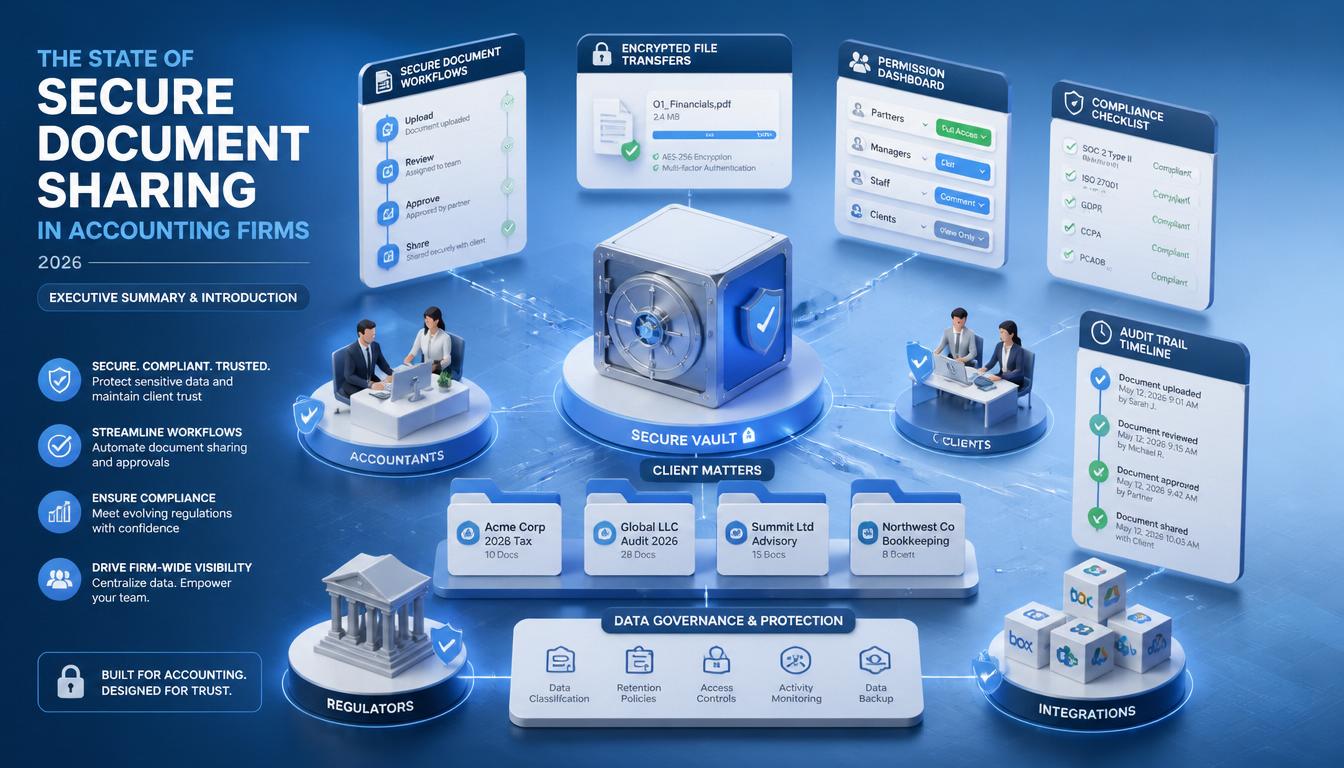
The State of Secure Document Sharing in Accounting Firms (2026)
Post 1 of 10: Executive Summary & Introduction
This is the first post in a ten-part research series examining secure document sharing in accounting firms. View the full series index here.
About This Series
Accounting firms handle some of the most sensitive documents in the economy. Every day, tax returns, payroll files, bank statements, identity documents, financial statements, and audit evidence move between firms, clients, regulators, and third parties. And every day, the methods most firms use to share them fall dangerously short of modern security and compliance standards.
This ten-part series provides a comprehensive, evidence-based examination of secure document sharing in accounting firms in 2026. It covers the threat landscape, regulatory environment, workflow realities, technology options, best practices, and strategic implications — culminating in a detailed analysis of why controlled-access links represent the next evolution in secure document sharing.
Executive Summary
Accounting firms now operate in one of the most sensitive data environments in the professional services sector. Every engagement — from tax preparation to payroll processing, from bookkeeping to audit — requires the constant exchange of high-value personal and financial information with clients, regulators, and third-party stakeholders.
Yet despite the escalating threat landscape, most firms continue to rely on outdated, insecure, and operationally fragile document sharing methods — particularly email attachments and consumer cloud links.
The findings of this research are clear: secure document sharing is no longer a “nice to have.” It is now a foundational operational requirement for every accounting firm, regardless of size, location, or client base.
The Rising Threat Landscape
Cyberattacks targeting financial data have surged dramatically. Accounting firms — especially small and mid-tier practices — are increasingly targeted because they hold high-value documents but often lack enterprise-grade security infrastructure.
Phishing remains the dominant attack vector, responsible for the vast majority of breaches. Attackers now use AI-generated emails, spoofed cloud-sharing links, and credential-harvesting pages that mimic legitimate platforms with alarming accuracy.
Insider threats are also rising, driven by poor access controls, shared passwords, unsecured personal devices, and informal document-handling habits. Seasonal workload spikes — particularly during tax time — create rushed workflows that increase the likelihood of mistakes, misdirected documents, and accidental exposure.
The cost of a breach continues to climb. Financial sector incidents average more than USD 6 million in direct and indirect losses. For small accounting firms, even a minor breach can be catastrophic — damaging reputation, triggering regulatory investigations, and eroding client trust that took years to build.
Compliance Pressures Intensifying
Accounting firms must comply with multiple overlapping regulatory frameworks. In Australia, the Privacy Act 1988, the Australian Privacy Principles (APPs), and ATO digital security expectations impose strict requirements for handling personal and financial information. Globally, GDPR, HIPAA, SOC 2, and ISO 27001 influence how firms manage data.
Regulators increasingly expect firms to demonstrate:
- Encryption in transit and at rest
- Access controls and least-privilege permissions
- Audit trails and activity logs
- Secure client communication channels
- Document retention and deletion policies
- Breach notification readiness
Email attachments and consumer cloud links fail many of these requirements. They lack granular access control, do not provide reliable audit trails, and expose firms to credential theft, misdelivery, and unauthorised forwarding.
Workflow Realities
The daily operations of accounting firms create unique security challenges. Clients frequently send documents through insecure channels — email attachments, unprotected PDFs, shared drive links, and even photos taken on mobile phones. Staff often work across multiple devices, including personal laptops, increasing the risk of unauthorised access.
Document volumes are high, deadlines are tight, and workflows are complex. Firms must collect, organise, review, annotate, and archive documents across multiple engagements simultaneously. Traditional methods create bottlenecks, version control issues, lost attachments, and inconsistent client experiences.
The Technology Landscape Is Shifting
The market for secure document sharing solutions has expanded significantly. Firms now have access to encrypted client portals, virtual data rooms, enterprise cloud platforms, controlled-access link systems, and AI-driven audit document collection tools.
Each category offers different strengths and limitations. Portals are secure but often cumbersome for clients. Virtual data rooms are powerful but expensive and impractical for everyday accounting workflows. Consumer cloud platforms offer convenience but lack accounting-specific controls.
Controlled-access links — such as those provided by FileRecall — offer a modern balance of security, simplicity, and workflow efficiency that no other category can match.
The Strategic Imperative
The strategic implications are clear. Firms that modernise will gain:
- Reduced breach risk
- Stronger compliance posture
- Faster, more efficient workflows
- Higher client satisfaction and trust
- Better audit readiness
- Lower operational overhead
- Competitive advantage
Firms that fail to modernise will face:
- Increased likelihood of cyber incidents
- Regulatory exposure and potential penalties
- Inefficient, error-prone workflows
- Lost clients to more digitally capable competitors
- Higher insurance premiums
- Reputational damage that compounds over time
Secure document sharing is now a core operational capability — not an optional enhancement.
Introduction & Research Scope
Secure document sharing has become one of the most critical operational capabilities for accounting firms in 2026. The profession sits at the intersection of sensitive financial data, regulatory scrutiny, and high-volume client interaction — a combination that creates both significant opportunity and significant risk.
As firms increasingly adopt digital workflows, the methods used to exchange documents have become a defining factor in security posture, compliance readiness, client trust, and overall operational efficiency.
Purpose of This Research
This series has four purposes:
1. To define the current security and workflow challenges facing accounting firms. Accounting firms handle some of the most sensitive documents in the economy — yet many still rely on insecure, outdated, and operationally fragile methods for exchanging them. This series outlines the risks, inefficiencies, and compliance gaps created by legacy workflows.
2. To evaluate the modern technologies available for secure document sharing. The market has evolved significantly. This series compares encrypted portals, virtual data rooms, enterprise cloud platforms, controlled-access link systems, and AI-driven audit tools — and explains why controlled-access links represent the next evolution in secure sharing.
3. To provide a strategic framework for firms seeking to modernise. Secure document sharing is not just a security requirement — it is a workflow and client-experience imperative. This series provides actionable guidance for firms looking to upgrade their document sharing infrastructure.
4. To position FileRecall as a leading solution for accounting firms. FileRecall’s controlled-access link model aligns directly with the security, compliance, and workflow needs of modern accounting practices. This series demonstrates how and why FileRecall fits the future of accounting document workflows.
Who This Series Is For
This research is designed for:
- Accounting firm owners and partners
- Practice managers and compliance officers
- Bookkeepers and audit teams
- Technology decision-makers in accounting practices
- Cybersecurity consultants serving the accounting sector
- Software vendors and advisers evaluating the accounting technology landscape
Why This Matters Now
The accounting profession is undergoing rapid digital transformation. Remote work, cloud adoption, AI-driven tools, and evolving client expectations have reshaped how firms operate. Yet document sharing — one of the most fundamental workflows in accounting — remains stuck in outdated patterns.
Email attachments, shared drive links, and ad-hoc cloud uploads are no longer acceptable. They expose firms to cyberattacks, compliance violations, workflow inefficiencies, and client frustration. Regulators expect stronger controls, insurers demand better security posture, and clients increasingly prefer simple, secure, mobile-friendly methods.
The shift toward controlled-access links represents a major evolution in secure document sharing. This series explains why — and why FileRecall is positioned to lead that evolution.
What’s Coming in This Series
Each post in this series builds on the last, taking you from the current threat landscape through to a practical framework for modernising your document sharing workflow:
- Post 2 — Industry Context: Why Secure Sharing Matters
- Post 3 — The Threat Landscape Facing Accounting Firms
- Post 4 — Regulatory & Compliance Environment
- Post 5 — Workflow Realities Inside Accounting Firms
- Post 6 — The Technology Landscape
- Post 7 — Best Practices for Secure Document Sharing
- Post 8 — Strategic Implications for Accounting Firms
- Post 9 — FileRecall Positioning
- Post 10 — Conclusion & References
Related Reading
- Secure File Sharing for Accountants — how FileRecall fits into accounting workflows
- Secure Document Viewer — documents viewed in browser, never downloaded
- Secure File Sharing for Business — broader business document security context
- Expiry Controls — automatically limit how long documents remain accessible
- Access Tracking — full visibility into when and how documents are viewed
- Password Protection — add authentication before documents can be opened
- Instant File Recall — revoke access to any document at any time
This is Post 1 of 10 in the State of Secure Document Sharing in Accounting Firms (2026) series. Continue to Post 2 →
FileRecall — Secure document sharing for accounting firms. filerecall.com